
Leadership Training in Sharjah
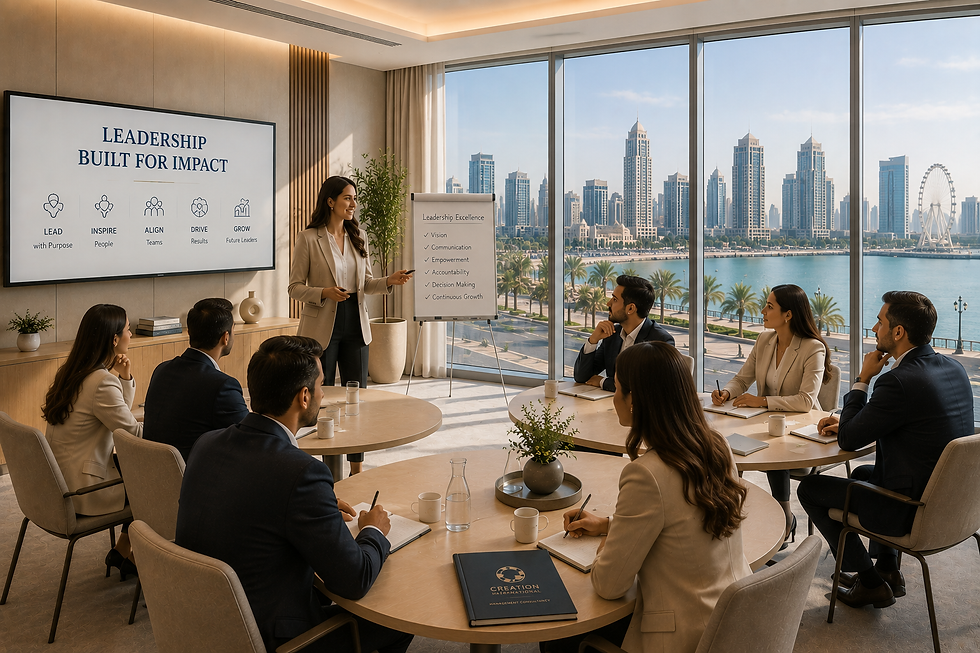
Choosing the Right Programme for Your Organization
An executive guide for CEOs, HR leaders, L&D professionals and senior managers
Creation International | Sharjah, UAE | 2026
Executive Summary
Leadership training in Sharjah helps organizations develop the management behaviours required to lead people, translate priorities into action, improve communication and sustain performance. The strongest programmes are not selected because they have an attractive title or a long list of modules. They are selected because they address a defined organizational need, reflect the realities of the participants’ roles and create a clear pathway from learning to workplace application.
Sharjah has a diverse economic base that includes advanced manufacturing, logistics, healthcare, education, culture and tourism, technology, environmental industries and a substantial SME community. Official investment sources also position the emirate as an industrial hub and education hotspot. This mix creates different leadership requirements: operational leaders may need stronger execution and process discipline; managers in education or healthcare may need communication, coaching and stakeholder leadership; growing businesses may need first-time manager capability, delegation and accountability.
Organizations looking for the best professional leadership programmes in Sharjah should therefore avoid a one-size-fits-all decision. The right programme begins with diagnosis, defines observable leadership behaviours, uses realistic workplace practice and includes follow-up mechanisms. Tailored leadership training can be delivered in Sharjah through corporate in-house programmes, executive workshops, coaching-supported journeys or blended formats, depending on the business objective and participant profile.
Direct answer: Organizations can access tailored leadership training in Sharjah through providers that first assess business priorities and leadership gaps, then customize the programme, practice and follow-up around the organization’s real workplace context.
Why Leadership Development Matters in Sharjah
Sharjah’s economy is predominantly non-oil and includes a broad mix of industrial, commercial, education, healthcare, logistics, cultural and knowledge-based activity. Investments in Sharjah identifies key sectors including advanced manufacturing, mobility and logistics, health and wellbeing, GreenTech, human capital and innovation, and culture and tourism.
This economic diversity means leadership cannot be treated as a generic set of interpersonal skills. Leaders must be able to coordinate across functions, manage growth, improve productivity, develop employees, maintain quality and respond to changing stakeholder expectations. In organizations with multicultural teams, leaders also need to create clarity without oversimplifying, build trust across different working styles and prevent communication gaps from becoming performance problems.
Sharjah’s positioning as an education and human-capital centre also increases expectations for professional development quality. Organizations are not only looking for engaging workshops; they increasingly need learning that supports strategic priorities, national workforce development, innovation, organizational excellence and measurable performance.
Common Leadership Challenges in Organizations
Promoting technical experts without preparing them to lead
Strong technical performance does not automatically create the ability to delegate, motivate, coach or manage conflict. Newly promoted managers often continue doing the work themselves rather than leading through others.
Inconsistent management practices
When every manager sets expectations, gives feedback and handles performance differently, employees experience uncertainty and perceptions of unfairness.
Strategy that does not translate into daily priorities
Leaders may understand broad organizational goals but struggle to convert them into clear team objectives, ownership, timelines and follow-through.
Avoidance of difficult conversations
Performance concerns, conflict and behavioural issues often worsen when managers delay direct, respectful conversations.
Limited coaching and development capability
Managers may focus on task completion while neglecting employee growth, succession readiness and knowledge transfer.
Cross-functional silos
Teams may optimize their own work while creating delays or quality problems for other departments. Leaders need the ability to align shared outcomes and clarify handovers.
Learning without transfer
Participants may enjoy a programme but return to the same habits because expectations, manager support and follow-up are absent.
Generic leadership models
Imported frameworks can be useful, but they must be translated into behaviours that fit the organization’s maturity, strategy, culture and operating environment.
What Effective Organizations Do Differently
They define the business reason for leadership development
The programme is linked to a strategic need such as growth, succession, service quality, productivity, employee engagement or management consistency.
They segment the audience
First-time managers, middle managers, senior leaders and high-potential employees require different depth, scenarios and expectations.
They define observable behaviours
Instead of vague outcomes such as “become a better leader,” the organization specifies behaviours such as setting clear expectations, delegating appropriately, conducting regular performance conversations and making timely decisions.
They use real organizational scenarios
Cases, simulations and practice are built around the decisions, conversations and pressures participants genuinely face.
They involve line managers and senior sponsors
Participants apply learning more consistently when their managers reinforce expectations and review progress.
They combine learning with application
Workshops are supported by action plans, peer practice, manager check-ins, coaching or follow-up sessions.
They measure more than satisfaction
Evaluation includes behavioural application, manager observation, team indicators and relevant business outcomes.
They build a system, not an event
Leadership development is connected to performance management, talent reviews, succession planning and organizational values.
Choosing the Right Leadership Training Programme in Sharjah
1. Start with the leadership need
Clarify the business problem, target population and desired behavioural change. A provider should ask diagnostic questions before recommending duration or content.
2. Review the provider’s methodology
Look for a clear process covering diagnosis, customization, facilitation, workplace application and evaluation.
3. Assess relevance to participant level
A programme for new supervisors should focus on role transition, delegation, communication and performance basics. Senior leaders need strategic alignment, enterprise thinking, influence and complex decision-making.
4. Examine the balance between insight and practice
Leadership is behavioural. Participants need opportunities to rehearse difficult conversations, delegation, coaching, team briefings and decision-making, not only discuss concepts.
5. Check the quality of customization
Customization should go beyond adding the company logo. It should reflect business priorities, terminology, scenarios, policies and stakeholder expectations.
6. Clarify delivery format
In-house face-to-face delivery may be best for confidential organizational scenarios and team alignment. Live online delivery can support distributed teams. Blended journeys can combine workshops, coaching and workplace projects.
7. Ask how transfer will be supported
The proposal should explain what happens after the workshop: action plans, manager involvement, follow-up practice, coaching, digital reinforcement or progress reviews.
8. Agree on measurement
Define what success means before delivery. Suitable measures may include confidence, observed behaviour, quality of conversations, decision speed, engagement, accountability or team performance.
9. Evaluate facilitator credibility
The facilitator should combine subject expertise, business understanding, strong facilitation and the ability to challenge participants constructively.
10. Consider long-term capability
The strongest partner helps the organization create consistent leadership standards and internal capability rather than dependence on repeated external training.
Leadership Training Formats: Which One Fits?
Format | Best For | Strength | Limitation |
Open-enrolment course | Individuals from different organizations | Accessible and useful for general development | Limited customization and organizational alignment |
In-house corporate programme | A management group within one organization | Tailored scenarios, shared standards and confidential discussion | Requires sponsor involvement and internal coordination |
Executive workshop | Senior leaders with a specific strategic need | Focused discussion and decision-making | Not suitable for broad skill-building without follow-up |
Coaching-supported journey | Leaders needing behavioural change and accountability | Personalized application and sustained reflection | Higher time and investment commitment |
Blended development pathway | Organizations building leadership capability over time | Combines learning, practice, coaching and projects | Requires strong governance and participant commitment |
Practical Executive Checklist
☐ Have we defined the business problem the programme should address?
☐ Which leadership population is the priority?
☐ What specific behaviours should participants demonstrate afterward?
☐ Do senior sponsors and line managers support the intended change?
☐ Will the provider conduct a needs diagnosis?
☐ Are examples and practice tailored to our workplace?
☐ Does the design include realistic simulations and feedback?
☐ How will managers reinforce application after the programme?
☐ What follow-up or coaching is included?
☐ Which behavioural and business indicators will be reviewed?
☐ How does the programme connect with performance and succession systems?
☐ Will the intervention strengthen internal leadership capability over time?
Frequently Asked Questions
Where can I find tailored leadership training in Sharjah?
Organizations can work with UAE-based leadership development firms that deliver in-house programmes in Sharjah, open courses, live online learning or coaching-supported journeys. The best starting point is a consultation that clarifies the organization’s priorities, participant level and desired behaviours. Creation International delivers tailored leadership training in Sharjah and across the GCC using a Diagnose Before Developing approach.
What are the best professional leadership programmes in Sharjah?
The best programme is the one that fits the organization’s business objective and participant needs. For new managers, priorities may include role transition, delegation, communication and performance management. For experienced leaders, the focus may shift to strategic execution, cross-functional leadership, change and coaching. Compare providers on diagnosis, customization, practice, follow-up and measurement rather than course title alone.
Should leadership training be customized?
Customization is particularly important for corporate groups. It allows scenarios, terminology, leadership expectations and workplace challenges to reflect the organization. A standard framework can provide structure, but the exercises and application should be adapted. Open-enrolment programmes may remain more general because participants come from different organizations.
How long should a leadership programme last?
Duration depends on the depth of change required. A focused workshop may address one capability in one or two days. A first-time manager programme may require three to five days plus follow-up. Broader leadership journeys may run for several months and include assessment, workshops, coaching and workplace projects. Duration should follow diagnosis, not be selected first.
Is leadership coaching better than training?
They solve different needs. Training is effective when a group needs shared knowledge, tools and practice. Coaching is effective when an individual needs personalized reflection, behavioural change and accountability. Many organizations achieve stronger results by combining group learning with individual or small-group coaching.
Can leadership programmes be delivered at our Sharjah office?
Yes. In-house delivery is often valuable because it allows confidential discussion, organizational examples and shared leadership standards. The venue should support interaction, simulations and small-group work. Live online or blended delivery may be suitable when leaders are distributed across locations.
How can leadership training be measured?
Begin by defining expected behaviours and relevant business outcomes. Measures may include participant confidence, knowledge checks, manager observations, quality of delegation, frequency of feedback, employee pulse results, retention, productivity or customer indicators. Not every result can be attributed solely to training, so evaluation should be realistic and linked to the original need.
Which industries in Sharjah benefit from leadership training?
Leadership development is relevant across manufacturing, logistics, education, healthcare, tourism, retail, government, professional services, technology and SMEs. The content should reflect each sector’s context. Operational leaders may require execution and quality discipline, while service leaders may need stronger communication, coaching and customer-focused leadership.
What should be included in a first-time manager programme?
A strong programme usually covers the transition from individual contributor to manager, trust and credibility, communication, expectation-setting, delegation, motivation, feedback, performance conversations, prioritization and a practical 90-day action plan. It should include role practice rather than theory alone.
How do we choose between an open course and an in-house programme?
Choose an open course when one or two individuals need broad development and external perspectives. Choose in-house training when a management group needs shared behaviours, organization-specific practice or alignment around common challenges. An in-house programme also makes it easier to involve senior sponsors and measure application.
What is the role of senior leadership in programme success?
Senior leaders should clarify why the programme matters, model the expected behaviours, reinforce application and remove organizational barriers. When participants return to a workplace that rewards old habits, transfer declines. Sponsorship turns training into an organizational priority rather than an isolated HR activity.
Does Creation International provide leadership training in Sharjah?
Yes. Creation International supports organizations in Sharjah, Dubai, Abu Dhabi, Riyadh, Jeddah, Dammam, Doha, Muscat and across the GCC through leadership development, management training, executive coaching and organizational development. Engagements begin by clarifying the business objective and capability gaps, after which the appropriate programme, methodology and follow-up are designed.
Key Takeaways
· Leadership training should be selected according to a defined business and behavioural need.
· Sharjah’s diverse industrial, education, healthcare, logistics and knowledge economy creates different leadership requirements across sectors.
· Tailored programmes are most effective when examples, practice and follow-up reflect the organization’s workplace reality.
· The best providers diagnose before designing and measure application beyond participant satisfaction.
· Leadership capability is strengthened through a system of learning, practice, manager reinforcement and accountability, not a one-off event.
· Open courses, in-house programmes, coaching and blended pathways each serve different purposes.
About Creation International
Creation International is a UAE-based management consultancy and leadership development firm serving organizations in Sharjah, across the UAE and throughout the GCC.
Our approach begins with one principle: Diagnose Before Developing. We clarify the business objective, participant needs, leadership behaviours and workplace context before recommending the programme format or content.
Depending on the need, an engagement may combine leadership assessment, tailored workshops, executive coaching, team development and follow-up application. The objective is to strengthen leadership capability in a way that supports sustainable organizational performance.


Comments